

The Patrol Guard System is designed to help Law Enforcement do their job and get home safe
There is nothing like the Patrol Guard System on the market today.
For the past several years, we have all watched the news and seen the same dangerous situations unfold:
• Patrol vehicles surrounded by aggressive individuals.
• Protesters blocking roadways after lawful orders to disperse.
• Officers trapped inside their vehicles with no safe avenue for escape or repositioning because of rioters.
• Law enforcement personnel operating in high-risk environments where their only options are to use deadly force or remain in place and risk assault or serious injury.
That is not acceptable—not today, not tomorrow, not ever.
Law enforcement officers deserve additional tools that can help create distance, improve safety, and provide more options during rapidly evolving incidents.
The answer is the Patrol Guard System.
Patrol Guard System
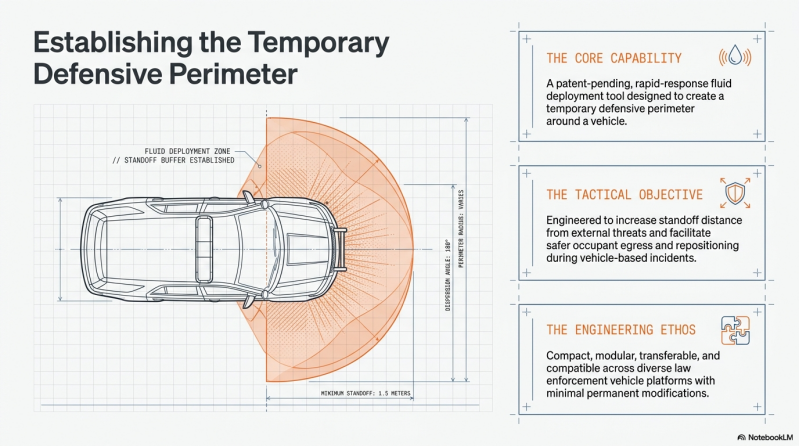
The Patrol Guard System (P.G.S.) is designed to give officers and vehicle occupants an additional tool when confronted with hostile, non-compliant, or threatening individuals around a vehicle. This system serves several purposes:
1. Creates Space Around the Vehicle
The system deploys a fluid perimeter around the front and sides of the vehicle, helping create separation between the vehicle and individuals approaching too closely. This can assist occupants in safely repositioning, exit, or remain inside the vehicle.
2. Enhances Occupant Safety
When a vehicle is surrounded or blocked, occupants can become vulnerable. The Patrol Guard System is intended to provide an additional defensive option that may help deter further approach and increase reaction time.
3. Assists During Crowd-Control Situations
In situations involving demonstrations, riots, roadway blockages, or large groups of people, the system can help establish a temporary standoff distance around the vehicle without requiring occupants to immediately leave the vehicle.
4. Supports Safe Vehicle Egress
One of the primary goals of the Patrol Guard System is to facilitate safer entry and exit from a vehicle when conditions outside may be hostile or unpredictable.
5. Provides a Vehicle-Mounted Force Multiplier
The system allows a patrol vehicle, tactical vehicle, or security vehicle to carry a readily available defensive perimeter capability without requiring additional personnel or equipment deployment.
6. Rapid Deployment
The Patrol Guard System is designed for quick activation from inside the vehicle, allowing operators to respond immediately when a situation develops.
7. Transferable Between Vehicles
Because the system uses quick-connect wiring and hoses, agencies can move the unit between vehicles more easily, reducing costs and increasing flexibility.
How the System Works
1. Fluid Storage
A chemical-resistant tank mounted inside the vehicle (typically in the cargo area, bed, or rear compartment) holds the selected liquid. The tank is connected directly to the pump assembly.
2. Pump Activation
When the operator presses the activation switch inside the vehicle, a pump draws fluid from the tank and pressurizes the system.
3. Fluid Distribution
The pressurized fluid travels through chemical-resistant hoses routed from the tank toward the front of the vehicle. Quick-connect fittings allow the system to be removed and transferred between vehicles more easily.
4. Pressure Regulation
A pressure-control component regulates flow to help maintain a consistent spray pattern and coverage area.
5. Nozzle Deployment
The fluid exits through 6 spray nozzles mounted away from the vehicle facing forward.
6. Coverage Area
The nozzles are adjusted to create overlapping spray zones around the front and sides of the vehicle. The system is configured to project fluid with so much force (60+PSI) that it's pushed beyond 6 feet from the vehicle with a spray width of roughly 3 feet at that distance.
7. Operator Control
The operator activates the system from inside the vehicle using a switch to power on, monetary button and selector switch. The goal is rapid deployment with minimal operator actions during a high-stress situation.
Typical Operating Sequence
- System is filled and powered.
- Vehicle encounters a situation requiring deployment.
- Operator presses the activation switch.
- Pump pressurizes the system.
- Fluid flows through hoses to the nozzles.
- Spray pattern forms a temporary perimeter around the vehicle.
- Operator releases the switch, stopping fluid flow.

4 -Position Selector Switch
The system incorporates a four-position rotary selector switch that allows the operator to choose the deployment zone prior to activation.
Switch Positions:
- Right Front Only
- Left Front Only
- Right Front and Left Front Simultaneously
- Off position
Operation
The selector switch routes power to the desired spray zone. Once a zone is selected, the operator activates the system using the momentary activation button. The system then deploys fluid only through the selected spray nozzles.
Example Uses
- Right Front Only: Threat approaching passenger-side front corner.
- Left Front Only: Threat approaching driver-side front corner.
- Right & Left Front: Creates a full front defensive perimeter.